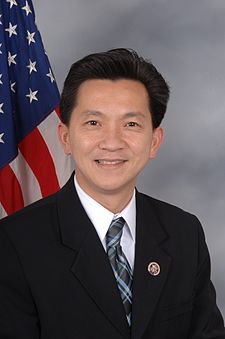
Anh "Joseph" Quang Cao (Vietnamese: Cao Quang Ánh, with Cao pronounced /ˈɡaʊ/ "gow" in English;[3] born March 13, 1967) is a New Orleans lawyer and the current U.S. Representative from Louisiana's 2nd congressional district. He is a member of the Republican Party. On December 6, 2008, Cao defeated nine-term Democratic U.S. Representative William Jefferson with 49.6 percent of the vote to Jefferson's 46.8 percent.
Cao is the first Vietnamese American as well as the first native of Vietnam to serve in Congress, and the first Republican to serve in his district since 1890; his district usually votes overwhelmingly Democratic.[4] Cao is the poorest member of Louisiana's delegation (including the state's two senators) in Congress: as of 2009 his assets were no greater than $195,000 and his potential liabilities mounting to $215,000.[5]
Cao previously ran unsuccessfully as an independent for District 103 of the Louisiana House of Representatives.[6] He was a delegate to the 2008 Republican National Convention. [7] At the time of his election to Congress, Cao was a member of the Orleans Parish Board of Election Supervisors.[8]
A devout Roman Catholic, Cao served as a board member for Mary Queen of Vietnam Catholic Church's Community Development Corporation[9] which assists Vietnamese-Americans with hurricane relief,[10] and is a member of the National Advisory Council of the U.S. Conference of Catholic Bishops.[11]
Family
Cao's father, My Quang Cao (born 1931), was a lieutenant in the Army of the Republic of Vietnam and was captured by the North Vietnamese Army at the end of the Vietnam War. His mother, Khang Thi Tran (born 1935), did not immediately flee South Vietnam. She stayed with Cao's five other siblings and visited his father while he was imprisoned in the reeducation camp. Cao was 8 years old when he arrived in the United States with two siblings and an uncle as a refugee.[12] Cao's father was imprisoned for seven years in a communist re-education camp, before being released and joining the three children in Houston, Texas. Both of Cao's parents, the mother pushing the wheelchair-bound father, attended their son's swearing-in ceremony in Washington, D.C. on January 6, 2009.[13] Cao is married to Hieu “Kate” Hoang; they have two daughters—Sophia and Betsy. The Caos live in New Orleans' Venetian Isles neighborhood. Kate and Joseph met, in 1998, at the Mary Queen of Vietnam Catholic Church in New Orleans East and have attended there since, with the children. After the 2008 election, Kate, an alumna of the Xavier University of Louisiana College of Pharmacy and a registered pharmacist, resigned from her position at a New Orleans Walgreens pharmacy.[14] Besides Cao's parents, Kate and the two children along with Wagner, people with a background in New Orleans, and a contingent of Vietnamese-Americans attended the swearing-in. Cao held 4-year-old Betsy in his left arm while raising his right arm for the oath. After the official swearing-in by Speaker of the House Nancy Pelosi, Jefferson Parish Judge Robert Murphy readministered the oath in front of a crowd assembled at Cao's new office.[15
Education
Cao almost became a Roman Catholic priest. He graduated from Jersey Village High School in Houston. He then earned a bachelor's degree in physics at Baylor University in Waco, Texas. He was a Jesuit seminarian for six years, but abandoned it, realizing it was not his vocation. [16] He earned his master's degree in philosophy from Fordham University and, in 2000, his J.D. from Loyola University School of Law in New Orleans. While in law school he also taught undergraduate courses in philosophy at Loyola.[
Law practice
Cao used his legal training and experience in immigration issues. He taught at a parochial school in Virginia and volunteered at Boat People SOS (BPSOS) to assist Vietnamese refugees and immigrants and help organize Vietnamese-American communities toward self-sufficiency. He served as a board member of BPSOS from September 1996 to March 2002. After working with Waltzer & Associates, Cao opened his own law practice specializing in immigration law. He decided to enter politics after seeing the ineffective government response to Hurricane Katrina, and soon became involved in leading New Orleans East residents to oppose a landfill.[17]
Situation
Incumbent U.S. Representative William J. Jefferson won the Democratic primaries in 2008. Jefferson had weathered a major challenge in the Louisiana 2nd congressional district election, 2006, overcoming allegations that he had inappropriately used members of a Louisiana Army National Guard unit to reach his home during the aftermath of Hurricane Katrina.[18]
In 2008 Jefferson also faced federal charges of bribery involving Nigerian business interests and was perceived as vulnerable, with only 25 percent of Democrats voting for him in the Democratic primary. Jefferson faced six African-American challengers, along with newscaster Helena Moreno,[19] all clamoring to change Louisiana's reputation for political corruption.[citation needed] In a runoff primary, Jefferson defeated Moreno by 57 percent to 43 percent in a vote largely along racial lines. Unopposed for the Republican nomination, Cao ran against Jefferson, as did Green Party candidate Malik Rahim and Libertarian Party candidate Gregory Kahn.[20] An earlier candidate, independent Jerry Jacobs, had withdrawn.[21]
Endorsements
On November 30, the New Orleans Times-Picayune endorsed Cao in an editorial,[22] while on its op-ed page columnist James Gill stated that Jefferson's reelection "is not going to happen".[23] The prospect of a serious general election in the heavily African American and Democratic 2nd district was startling, as the last Republican to represent the district was Hamilton D. Coleman, who left office in 1891.[24]
Cao's candidacy received the endorsements of the Alliance for Good Government, the Family Research Council's Action PAC, Jefferson Parish Sheriff Newell Normand, Louisiana Governor Bobby Jindal, Jacquelyn Brechtel Clarkson, Stacy Head, and singer/entertainer Pat Boone.[25] In the final days of the campaign Democrats Helena Moreno, who was defeated by Jefferson in the Democratic primary runoff election, and former District Attorney Harry Connick, Sr., endorsed Cao and recorded telephone messages to be played to voters. New Orleans Mayor Ray Nagin announced his support for Jefferson during the Democratic primary elections. The New Orleans Gambit Weekly, citing its opposition to Jefferson's alleged corruption and to Cao's noncommittal statements on embryonic stem-cell research, made no endorsement.[26]
Campaign
At first, Jefferson, as indicated by the New York Times on the day after his winning the Democratic nomination, was "heavily favored" to win against a Republican challenger.[27]
The campaign was characterized by what Jefferson's campaign called "overly negative" tactics on behalf of Cao's campaign by outside organizations, such as the National Republican Congressional Committee. References were made to Democratic Speaker of the House Nancy Pelosi's removal of Jefferson from the House Ways and Means Committee and entailed what USA Today termed a "barrage"[28] of automated telephone calls, including from a woman who identified herself as "Katy" and who cited Jefferson's federal indictment on 16 counts of corruption. In a meeting of African-American ministers, Reverend Samuel Butler claimed the reason was to "disenfranchise" African-American voters, which motivated Cao advisor and former New Orleans City Council member Bryan Wagner[29] to reply: "with Rev. Butler's imagination, he may want to go to work for Walt Disney."[30]
On December 6, the Times-Picayune reiterated its endorsement of Cao, pointing to President-Elect Barack Obama's efforts on behalf of Democrat Paul Carmouche in the simultaneous election in Louisiana's 4th congressional district and Obama's non-involvement in efforts to support Jefferson.[31]
On 2009 August 5, Jefferson was found guilty on 11 of the 16 indictment counts. His lawyers immediately promised to appeal the jury decision.[32]
Results
CNN, at 10:20 PM CST of the election day, projected Cao to win.[33] Complete unofficial results on the Louisiana Secretary of State's web site showed Cao with 33,122 (49.55%), Jefferson 31,296 (46.82%), Kahn 548 (0.82%), and Rahim 1,880 (2.81%).[34] Jefferson won by 23,197 to 20,246 in Orleans Parish, where 21 of the 392 precincts showed zero votes for Cao.[35] Cao, however, more than made up the difference with a margin of 12,696 to the incumbent's 8,099 in Jefferson Parish.[36] A post-election map analysis by the Times-Picayune showed the election result as having depended on higher turnout in the precincts favorable to Cao.[37]
After speaking by telephone 4 days after the election, on December 31, 2008, Wednesday, Jefferson and Cao met cordially at the home of New Orleans' Liberty Bank CEO Alden McDonald to discuss the transition.[38]
Significance
Politico.com declared Cao's victory one of America's "Top 10 Political Upsets" of 2008.[39]
Cao is the first Vietnamese-American elected to Congress. Cao's win rendered the 2nd District by far the most Democratic district in the nation to be represented by a Republican; the district has a Cook Partisan Voting Index of D+28.[40]
Cao's victory over a tainted incumbent became a cause for celebration among many in Louisiana. As stated by Jeff Crouere in his column Ringside Politics, "The victory strikes a major blow against the reputation of Louisiana as a corrupt state".[41]
House GOP members were particularly vocal in their glee over Cao's defeat of the Democrat. Among many other statements, House minority leader John Boehner asserted Cao's win as "a symbol of our future" in a memorandum with The Future Is Cao as its subject line.[42]
source
http://en.wikipedia.org/wiki/Joseph_Cao

No comments:
Post a Comment